自由转动杆与铰链固定杆倾倒时间对比研究
一、问题背景
某p大友人中午问了我一个问题

曾经自诩“高中物理领域神棍”的我也是体会了一把修为尽失的感觉…….可恶,还是,做不到吗。。。
才怪!现在我有了新的武器,解析不了我就暴力数值解嘻嘻
二、物理模型
2.1 自由杆(光滑地面)
- 约束条件:底端无水平约束,质心水平方向动量守恒
- 运动特点:质心同时有平动和转动
- 能量方程:$E = \frac{1}{2}mv_c^2 + \frac{1}{2}I_c\omega^2 + mg\frac{L}{2}\cos\theta$
2.2 铰链杆(固定底端)
- 约束条件:底端位置固定,绕该点纯转动
- 运动特点:质心作圆弧运动
- 能量方程:$E = \frac{1}{2}I_o\omega^2 + mg\frac{L}{2}\cos\theta$
三、动力学方程推导
3.1 自由杆的倾倒时间
1 | # 自由杆的角速度公式推导 |
3.2 铰链杆的倾倒时间
1 | # 铰链杆的角速度公式推导 |
四、数值计算方法
4.1 时间积分公式
倾倒时间通过对角速度倒数积分得到:
$$ t = \int_{\theta_0}^{\pi/2} \frac{1}{\omega(\theta)} d\theta $$
4.2 数值实现代码
自由杆计算代码
1 | import numpy as np |
铰链杆计算代码
1 | import numpy as np |
五、模拟结果分析
5.1 不同初始角度对比(默认杆长1m)
| 初始角度 | 自由杆时间(s) | 铰链杆时间(s) | 时间比(自由/铰链) |
|---|---|---|---|
| 1° | 1.1837 | 1.3668 | 想算的自己算 |
| 10° | 0.6648 | 0.7676 | |
| 30° | 0.4163 | 0.4807 | (—> __ —>) |
| 45° | 0.3201 | 0.3697 | |
| 60° | 0.2431 | 0.2807 | |
| 80° | 0.1338 | 0.1545 |
5.2 不同杆长对比(默认倾斜30°)
| 杆长(m) | 自由杆时间(s) | 铰链杆时间(s) | 时间比 |
|---|---|---|---|
| 0.5 | 0.2944 | 0.3399 | |
| 1.0 | 0.4163 | 0.4807 | |
| 2.0 | 0.5888 | 0.6799 | |
| 5.0 | 0.9309 | 1.0750 |
六、结论
自由杆下落更快!
但原因是什么呢
有没有能给我推导过程的QAQ
在线等~
附录:论AI目前为什么不能取代人类
请看vcr
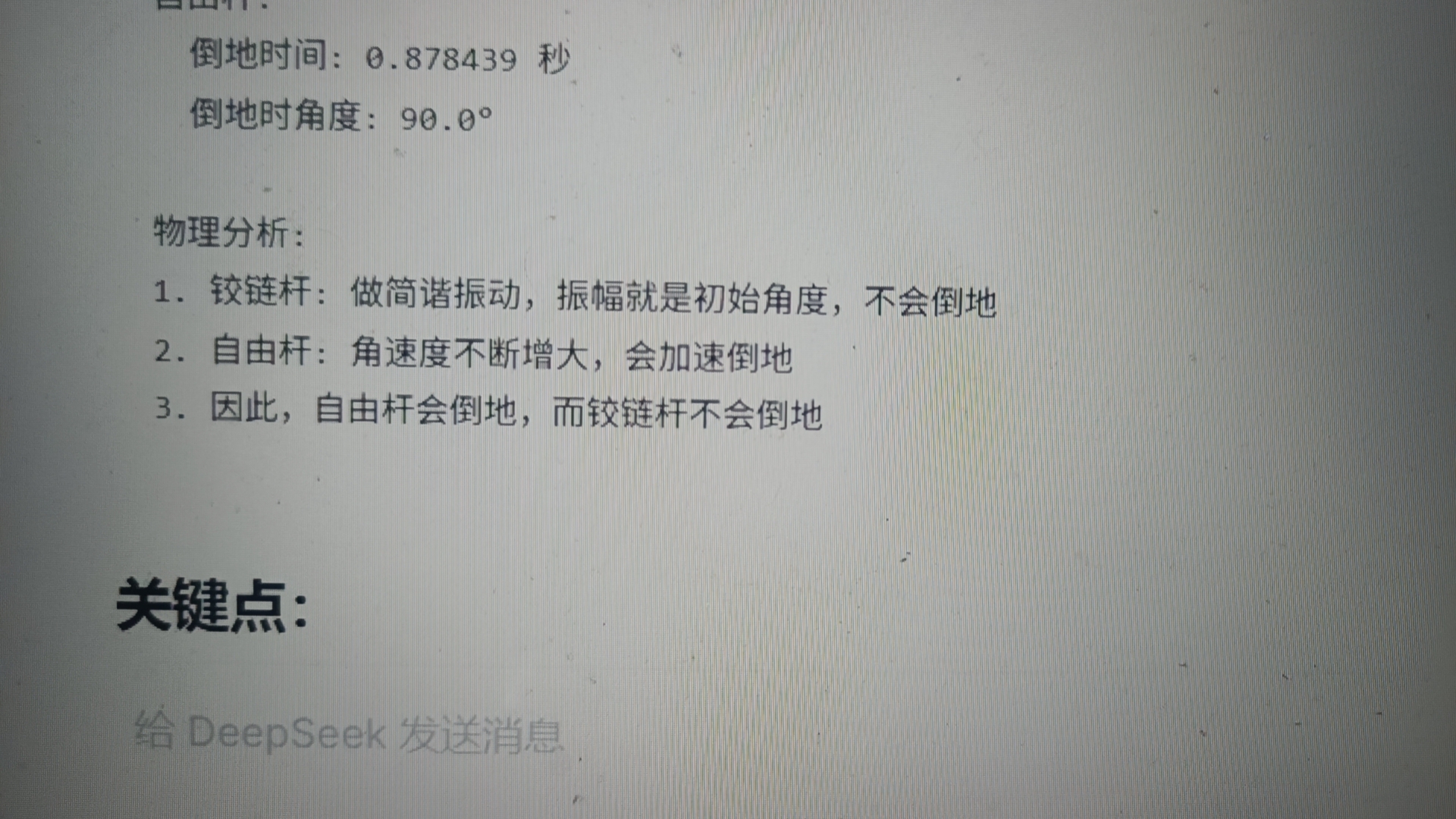
1.《有固定点,小角度?那就是简谐运动!》————来自亲爱的deepseek
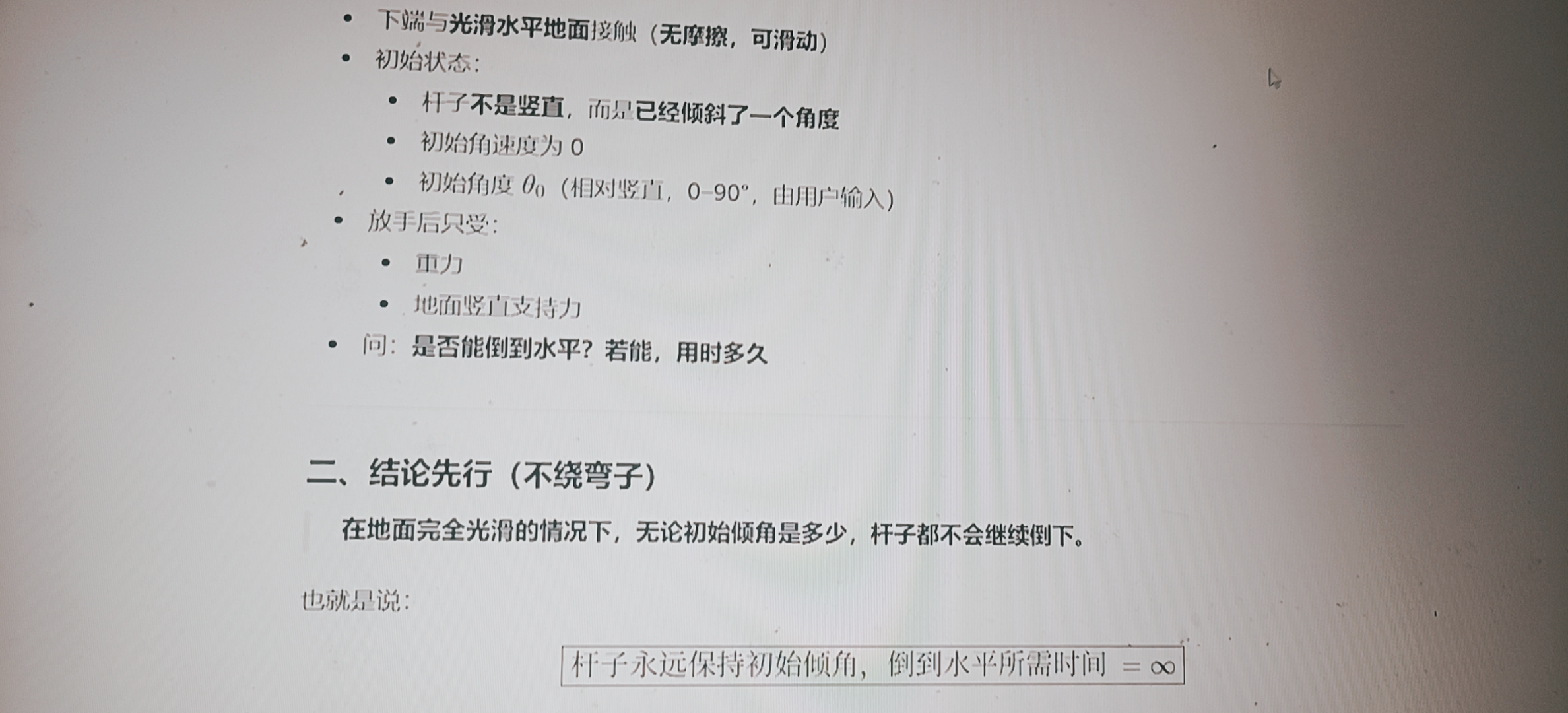
2.《什么是物理,我听不懂,倾斜的杆子就是不会掉下来,牛顿说啥我不管》
————GPT5 plus大人!\0/
建议加入ai笑话大全~